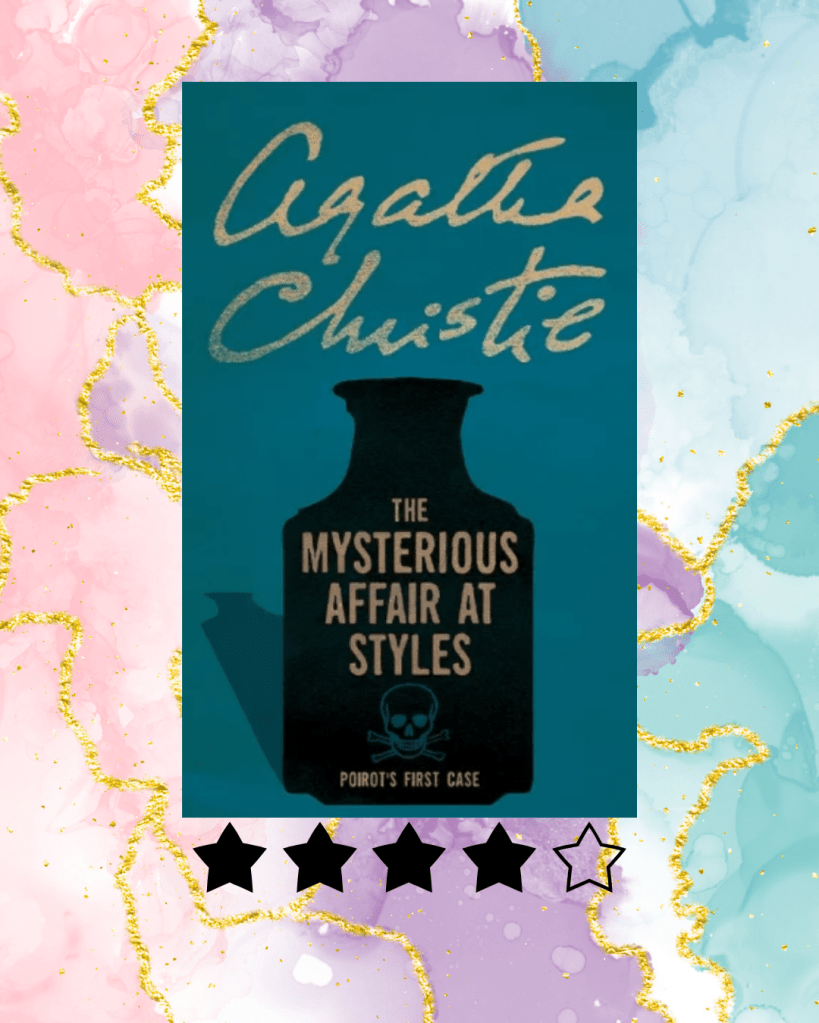
After the Great War, life can never be the same again. Wounds need healing, and the horror of violent death banished into memory.
Captain Arthur Hastings is invited to the rolling country estate of Styles to recuperate from injuries sustained at the Front. It is the last place he expects to encounter murder. Fortunately he knows a former detective, a Belgian refugee, who has grown bored of retirement …
I’ve been wanting to read the Poirot books for ages. I love the series with David Suchet. I even have the first four books on my bookshelf. They’ve been there for years, unread. I finally decided that if I was going to make my way through this series, it would be on audiobook and during my commute. This first book is narrated by a full cast with Peter Dinklage voicing Poirot. I don’t know whether I am biased towards David Suchet, but there is something about the accent Peter Dinklage uses that grates on me.
However, this book has filled my commute for the past week, and I must say it has been riveting. I have greatly enjoyed exploring this book and developing my own theories. Generally speaking, Agatha Christie falls under what most people would call “cosy crime”. I like to disagree because I cannot stand cosy crime as I find them predictable, easy to solve, and overwhelmingly dull. Maybe I just have a soft spot for Agatha Christie, or maybe she is just that good an author. Unless I’m actively looking for the murderer, I don’t see it in time. There are certain Agatha Christie books where I see the murderer coming from the first page. The Agatha Christie play “The Mousetrap”, for instance, was incredibly easy to solve. “Why Didn’t They Ask Evans?” was also an easy solve.
I’ve purposefully been avoiding thinking too hard while listening to this; it also helps that I’ve been focused on driving and staying safe! I sort of forgot that Hastings was wounded in the war and returned to England while it was still ongoing. I also never realised that Hastings had previously met Poirot and invited him into the house to solve a death, or that Poirot had been sponsored by the very lady of the house to leave Belgium and live safely in England. I think I always assumed their friendship came about in much the same way as Sherlock and John, which is very presumptuous of me.
Despite it all, I half-guessed the players by the end, but I didn’t correctly guess the murderer, and I will take that as a win. It was a very curious experience listening to this first Poirot book. I feel like I had a lot of expectations for it, and also no expectations at all. I think Agatha Christie is one of the only authors who can make the obvious choice of a murderer seem complicated and unusual. I myself had completely disregarded who the murderer was; I’d followed the rope that Christie had given me.
Poirot is like coming home. A rainy day when you’re stuck inside. Over the summer, I visited Agatha Christie’s summer home in Dartmouth, and the fact I learned that still bounces around my brain hole is that she didn’t drink alcohol…she drank glasses of double cream instead. Honestly, the thought of drinking double cream makes me feel awfully queasy, but if it worked for her, who am I to knock it?
Though I haven’t written as thorough a review as I do for other reads/audiobooks, I did enjoy listening to this. I found it difficult to separate the TV show from the audiobook. Poirot has always been a family favourite, so I knew a lot about the character before I learned about the writer when I was younger. I am trying to approach the series with a blank mind because adaptations of books can differ, and I want to absorb as much of the books as I can and read/listen to them in the way they were intended.
The second book, “Murder on the Links”, is narrated by Hugh Fraser, who played Captain Hastings opposite David Suchet’s Poirot on ITV, so I am expecting a good listen because his voice is naturally soothing.
I think the full cast adaptation of this book, “The Mysterious Affair at Styles”, was well done overall. I did take Umbridge with Peter Dinklage’s accent. I felt it was too heavy on the French, but I think that is just because I am used to David Suchet’s subtle one. This audiobook is just under 4 hours, so it is easy to consume. I think it was a good intro to the series, and for someone who has never read Christie before, a full-cast adaptation is a good way to experience her work.
 At the End of the World is a Book