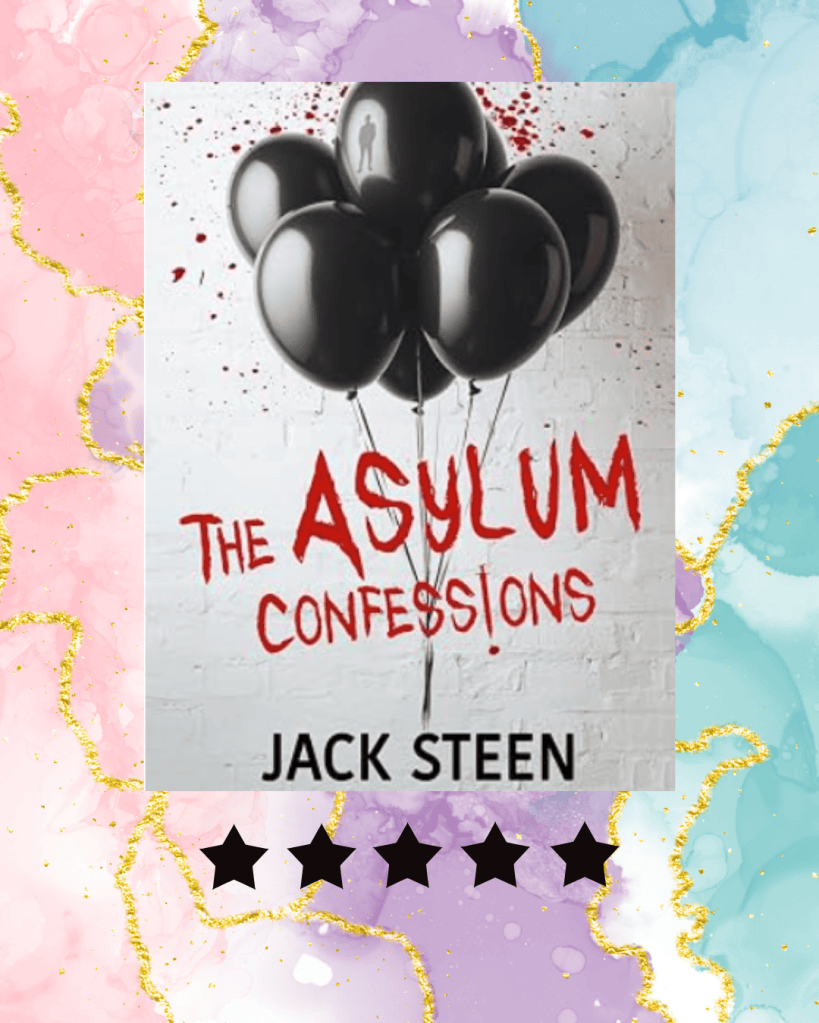
They arrive alive. They always leave dead.
But first, they give me their confessions.
My name is Jack Steen, and for those who arrive on my ‘death’ ward at the Asylum, I’m the last face many will see before they die. I am the night nurse at an Asylum for the Criminally Insane, and most of my patients know me as their Angel of Death. I know them as mass murderers, rapists, and serial killers – among other things.
Here’s what happens: they come on my floor, they give me their deathbed confession, and I help to make their death less painful. There’s a catch, though: I want the real story, the one they haven’t told anyone else.
The majority of these killers are expert manipulators. They could be playing their final game with me by messing with my head.
Now, maybe they’re messing with yours too.

The narrator of this book is Ben Fortune-Price
I CANNOT REVIEW THIS WITHOUT TALKING ABOUT ASPECTS THAT ARE SPOKEN ABOUT IN THE BOOK. I AM NOT GIVING AWAY SPOILERS, JUST MENTIONING PARTS THAT INTERESTED ME AND MY THOUGHTS AND OPINIONS ON THEM.
I came across this audiobook on Spotify. Probably prompted by all the true crime podcasts I listen to. Jack works in a ward where prisoners/patients come to die, and as such, he has earned the name ‘The Angel of Death’ for being the one who hears the deathbed confessions. He doesn’t mention the secure hospital where he works. However, if you are an avid true crime nut, it is pretty easy to work out.
We start with Patient 1024 – Chef. What struck me early on with this patient was a story from his childhood. His father owned a funeral home and also took calls out during the night to help those in need. His mother got annoyed with all the nightly phone calls, so she unplugged the phone. Unfortunately, on one of the nights that the phone was unplugged, a little girl died, and the mother couldn’t cope with the fact that had the phone been plugged in, the girl would have lived. She tucked Chef and Preacher (his brother) in bed, read them countless stories and told them how much she loved them. She died that night. Years later, Chef learned she died of an overdose; the guilt over the death of that child was too much for her to live with.
When he was eighteen, his father gave him the key to the basement. For a young man who idolised his father and sought his approval, finally earning the right to see the basement must have been a peak moment for Chef. It was, however, where things changed. Chef’s father harvested organs, buried them in a freezer under the floorboards, cooked those organs in a variety of ways and then fed them to the grieving families.
Twisted by his father’s joy, he was not repulsed but excited. It was at this point that I had to remind myself that Chef had been groomed by his father from a very young age and that, because of this, it would have been nigh impossible for him to have grown up without his father’s twisted behaviour impacting his own.
Death Eaters, Chef called himself and his father. The love for the families that they served was passed down, father to son, father to son. This was something that had been in practice for generations. The alternative death of his mother was revealed here. Not sure whether the story given here is true or whether it fuels his own story.
His first body was someone he knew. Picked by his father. The first one, according to his father, is always one who has lived a full life, and the heart is the organ to be harvested.
He was caught, ironically, by a nosy employee and an unlocked door. Chef says that his brother, Preacher, was never involved in this barbaric practice. He was a carpenter who had no idea what his father and brother were doing, although, if you believe the thoughts of the author, he is another killer in training. Chef planned to groom his nephew into the family business, but, well, he got caught.
He admits to Jack an act which he had never admitted before. He speaks of it so calmly, with no notion that he did anything wrong, and moves straight on to how he himself will be killed. How will they put him down? Chef told his story in four hours; he passed quietly, but asked that his heart be sent to his brother, Preacher… but no part of Chef will leave the asylum.
Chef seemed driven by an overwhelming need to please his father, to prove himself like him and to follow in his footsteps. Though his father did not open his eyes to what was really happening until he was an adult, Chef’s story reads like his father had groomed him from a young age. Little thoughts form the basis for his mind to act upon. I do not know whether it is true that his brother, Preacher, knew nothing of what was happening or whether Chef said that to protect him. I do not know how far back in the family this tradition went. Whether his father started it or whether it was passed down from his father. There was much speculation on whether their mother knew what was happening, and that is why she killed herself. I think we will never know her motives for death, but what is clear is that she felt very conflicted and guilty over the death of that little girl and saw the only solution as removing herself entirely. If Preacher is completely innocent, then I hope he lives the remainder of his life in peace. I hope that his son, the nephew Chef once sought to groom, lives a full and rewarding life in the sun.
Next, we meet Patient 974 – Ken & Barbie.
“Some people can’t be redeemed, no matter how close to death they sit.”
I appreciate Jack’s candour as he walks us through these patients. He gives no shits, and he takes no shits. He waits for them to die. He wants the story, he wants the confession. 14 adolescent girls’ lives were taken by Patient 974. Fourteen souls that never got to grow, and it’s clear this angers Jack. It should anger everyone. The very first girl has never been discovered. No matter how many family members, investigators and reporters visit, they have never told. The family deserves to mourn properly. Jack has waited for his deathbed confession, for the hope that this will be revealed.
I always assumed that Ken was the dominant one in this partnership, but listening to him talk. He was besotted with Barbie. He would have walked through fire if she asked him to. He talks about one of the first couples they targeted and how he wasn’t sure he had the confidence or the stomach to carry it out, but Barbie convinced him that he could do it and that he would enjoy it. He fed off her, and she fed off him. An almost perfect pairing of killers.
It’s so interesting hearing him talk. I know the case from listening to various people covering it on true crime podcasts, but there is something normal in hearing him talk about it that almost feels sinister. He talks about Barbie being the love of his life. I DIDN’T REALISE UNTIL AFTER I FINISHED THE BOOK THAT THIS ASYLUM SERIES IS FICTIONAL, NOT REAL LIFE. I’D BEEN READING WITH THE IMPRESSION THAT IT WAS REAL PEOPLE I WAS LEARNING ABOUT. KNOWING NOW THAT IT IS ALL FICTION MAKES IT MORE CREEPY.
The one he would have followed everywhere. He talks about how he wouldn’t change a thing, even though he has landed in prison as a patient, even though he took fourteen lives. He would do it all again if he could spend more time with Barbie. He was already an unpleasant person in his own right, and the way he talks has a slimy quality. It’s not that he’s gullible or easily manipulated; it’s that he’s besotted. Would he have gone to such lengths without her influence? Who’s to say? He says no. He says he was a little farm boy with no aspirations. He says that she was the one with influence; she was the one who said there was more to his life. He went along with it, yes, but he also wanted to do it. He enjoyed it.
Their first girl was special. So special that no other victim could have the same hair, features, name, etc. STACY. Her name was Stacy, and she was their roommate, a runaway. He makes a lot of statements about Stacy in regard to her sexual appetite. Jack steps in here, saying that Ken gets carried away with explicit details that add nothing to the story, so he removes what he has said. He states later that his level of detail would be like reading brutal porn, and you can do that anywhere without getting nauseous or horrified by what is being said.
Stacy was their first victim, the one that they never talked about and never picked up another who looked like her again. She was probably with them the longest, also. The way he talks, it’s like he thinks that she knew she was going to die and was okay with it. Like she was willing him to kill her. But the thing is, we only have his side of the story, and that will always be biased. He jokes about leaving town and being stopped by the police, who wanted to give Barbie some money for being their ‘favourite waitress’.
They preferred small towns. They could blend in more. Create a life for six months. When the need for Stacy returned, they hunted. They needed to relive that memory, but never took anyone who looked too much like Stacy. He skips from talking about their first victim to talking about their last victim. He says it was his fault they got caught, and that it soured his relationship with Barbie. He believes she died hating him. He thinks so much of her, even now.
Their last victim came about on the anniversary of the death of Stacy. According to Ken, Barbie was upset. Though she remained unconvinced, Ken decided to bring a girl into the fold. She looked like Stacy, which was the one thing they said they’d never take again, but that didn’t stop Ken. Usually, he says, they’d build up to it. Have them over a couple of times to build trust with the girls before going for the kill. Barbie wasn’t happy; she was angry with him for bringing this girl home, and he said he realised he had crossed a line with her. Barbie thought, rightly so, I guess, that this was how people got caught.
“If we get caught for this, I won’t forgive you, any other day, fine, but not today”, were the last words Barbie spoke directly to Ken.
It was such an opposite experience listening to this story. Through Chef’s story, I felt I came to understand his character better through his childhood, and though the acts he committed were criminal, Jack didn’t shy away from recounting them. I have felt, while listening to Ken, almost like I’m listening to a story that isn’t worth telling. I can understand why Jack has chosen to cut parts of Ken’s more graphic answers, and I definitely don’t want to go down that lane myself, but it does create a barrier to understanding the person and the reasons for committing these crimes. It feels almost abstract, as if it is happening above me, with a pane of glass separating us.
He talks about what sexual acts they did to their last victim, like he is talking about the weather. They got her comfortable, made her trust them. Made her relax. He talks like she was into it all, like she wanted what they did to her. Their victim, whom he refers to as Susie, narrowly misses being killed by Ken because she admits her father is a police officer. I can not imagine what that poor girl was thinking in that moment. Did she think she had said something to save her, or had she said something that ended her life?
Here, they deviated. Or rather, Barbie deviated. Ending the life of the poor young girl in a very graphic way. She was, in a way, completely fractured by the negative memory imposed on her beloved Stacy. They were incarcerated separately. He never saw her again, but it is clear that he still deeply loves Barbie and the life they shared. He holds no remorse for what he has done. He feels nothing for those girls. The only girl who holds space in his heart, besides Barbie, is Stacy, and even then, it is a twisted love.
Patient 871 – Bucket.
I don’t know what I expected when I began listening to this audiobook, but it has taken me to some interesting places. Here we meet Bucket, and, Contrary to what I have heard from Jack, he seems to share a bond with this woman. He speaks of her with familiarity, kindness, and sympathy. I was not introduced to her crime at first, unlike the other two patients. Instead, I was told how sweet and docile she was. How she didn’t like men but tolerated their presence. How the new doctor had upset her. He would calm her down. She’s dying of cancer. Cancer, which doesn’t discriminate and takes everyone. But people are not put in Jack’s ward because of cancer. They are put there for the terrible deeds they have done, so I have to wonder: what is Bucket’s sin?
FROM HERE ONWARDS, THE REVIEW WILL CHANGE SHAPE AS I REALISE AND RECOGNISE THIS IS A WORK OF FICTION AND NOT REAL-LIFE ACCOUNTS.
Bucket’s story is by far the most tragic and hard to hear in this book. I think it is because it is a first-hand account and because we are realistically aware that this sort of thing does happen in our world, as horrible as it is. The babies are terrifying. And overwhelmingly sad. It is a story that hits you hard in the chest, and it was the one I struggled with most. I think having Bucket age-regress, or be limited in her intellect, was the right move for the character; it makes her more palatable to listen to. Bucket’s story was short, but it wasn’t okay in any sense of the word. It was unpleasant, horrifying, unbelievably sad and a reminder of the horrors of the world. Bucket’s story involves rape, abuse, natural birth, and a painless death. Be warned when listening to this story.
Patient 1203 – The Nanny
The Nanny is an interesting character. A complex one that blurs the lines between true criminal murder and warped murder through an ideology. The Nanny’s ideology is that some people shouldn’t be parents. That some children need to be saved from their parents, whether they want that or not. From a traumatic experience during her own childhood, it is clear that it shaped her. It created a mantra she took to heart and let it twist her views. Her foster family, or adopted family, clearly didn’t trust her or believe that she was anything other than a ‘devil child’ which further warped her personality. She had a good start in life, but her life was set off the rails, and it never stopped rolling.
The friend she mentions throughout her story. The one who could charm her adoptive parents, the one who visited her often and then disappeared. I wondered about him. First seeing him as an imaginary friend, but later seeing him as the same man who murdered her own parents. Maybe he was checking up on her, or seeing how much of an impact he had had on her life. Either way, he was creepy.
This character draws the line and does not murder children, and it is framed in a way that makes you think ‘at least she has morals’, but realistically she still murders people in quite a gruesome manner, so the fact that she doesn’t also murder the children is a moot point. She is a murderer. You can be a murderer and still have morals, but it doesn’t detract from the point that you still murdered…
He gets her story, but she doesn’t get his death. She dies naturally. It is not a disappointment; it’s a reminder that life keeps turning whether you want to keep up with it or not.
Ending…
This was a wild ride. From thinking I was reading fact to realising it was fiction. This listen took me some places and some have yet to fade from my mind. It was great to listen to during my commute and when I was doing creative things. I know he has a whole series, so I will definitely be checking those out. This is dark, psychological thriller it most definitely is. I felt like I was coming back to the genre I love with this masterpiece. As an introduction to a new author, it was spellbinding. I know I’ve reviewed a different book he wrote, which I enjoyed less, but this was thought-provoking, completely captivating, and made me think about the human race and the wide capacity for immoral things we are capable of.

 At the End of the World is a Book