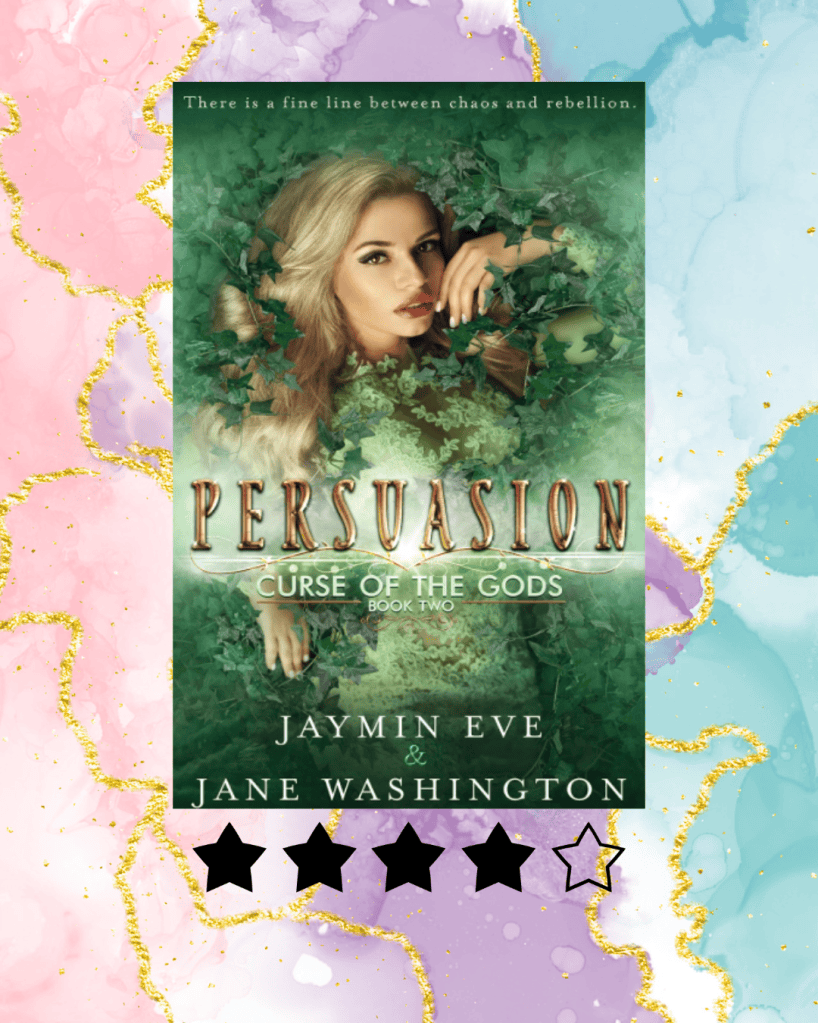
Willa Knight: Dweller? Bad-ass? Notorious pet to five magical beings?
In Blesswood, there are rules, and someone is trying to teach her how to follow them. The only problem is Willa. Which shouldn’t be anything new, since she has been a problem since birth—something her pseudo-sister Emmy would agree on.
So it definitely shouldn’t be new … but it is.
Because things are starting to happen that have never happened before.
Things are starting to get …chaotic.
Okay, so reading this book turned out to be pretty helpful in keeping my mind sane and my mental health stable. I had to go to a dental appointment to discuss some dental surgery I’m having and had to (A) drive to a new place and (B) go alone. So it was one of those difficult days with a lot of anxiety and stress, and my mind and body warring over whether we could do anything productive because we had a meeting at 3:30 pm. So, reading this book became a cathartic experience and calmed me down before and after the stressful moments of the day. When I finished book one and realised the books were named after the gift of each of the Abcurses, I expected each book to focus more on one of them, but that isn’t true. They are a unit, and each gets equal story time. I find why choose romances with gods to be rather interesting plots. I think it’s because there is so much room for movement and development outside the traditional academy/school setting most common in this genre. I mean, they are still in an academy, but it is more of a background element rather than being essential to the plot.
Willa –
Willa’s character has not changed. She is still as wacky, weird, and sarcastic as she was in the first book, and I love her all the more for it. I find her character refreshing and amusing. She’s a perfect fit for the book and a real testament to the author. Without her, or with a different FMC, it wouldn’t work nearly as well. Willa’s clumsiness is genuinely amusing; you can’t help but shake your head and laugh under your breath as she falls for the umpteenth time. She might be the lowest on the totem pole, but Willa is not a vulnerable damsel in distress; the men aren’t saving her from some alternative nightmare. Willa is the product of a series of unfortunate events, all unintentionally caused by her…Never ask this woman to carry hot water while walking! In this book, we learn more about the gods and Topia, where they reside. We get more of Willa’s sarcastic remarks and opinions of the gods that supposedly watch over all. She isn’t impressed with them and isn’t shy about it, much to the horror of those around her.
Coen – Pain
I think Coen and Aros struggle the most when it comes to Willa because their gifts are second nature to them and they are completely aware of what using their gift on Willa will cost, yet they are also very attracted to her, so there is always an element of indecision on how far they can walk before she gets burned. Coen (and his twin Rome) are quieter than the rest of them. They almost watch from the sidelines and then jump right into the fray without you realising they already had the knowledge to do so. If Willa is carried over someone’s shoulders, it’s probably Coen. He has a shorter limit on how many times Willa can trip up because causing serious damage, and it’s just easier to carry her. Coen is a strong presence; his character feels sturdy, and he can take point and lead when the need arises. You can see that he cares deeply for his brothers and has carved out another space for Willa.
Yael – Persuasion
Yael is still as demanding as ever. Still fighting to be named ‘number one’ even though he doesn’t reside in bedroom ‘one’. It’s sort of an ongoing gag, but it adds light to the plot when the darker themes or surprises are revealed. It’s clear that Yael’s gift is much more powerful than he’s led people to believe. It’s a good survival method, considering how volatile the gods are and now many people are watching to take them out. We get to see a variety of Yael’s persuasion gift in action in this book, and I think I read in awe while Willa watched in awe. They all adapted to being bound to Willa in some way in the first book. In this book, however, it became apparent just how much she meant to them and Yael, who uses dead-eye aggressive sarcasm on literally everyone else, became an exposed onion when interacting with Willa. It’s nice to see the characters fully developed and not caged into one specific trait.
Aros – Desire
Aro has a hard time controlling his gift when Willa’s emotions are high. It’s not fair to Willa that they all made a pack because she has no control over her desires and wants for these men, and yet they friend-zoned her without consent. It’s an interesting concept and makes for compelling plotlines. I think Aro is used to people wanting him to use his gift, or wanting to know him because of it. He seems to relish his gift and hide it at the same time. There are definitely more layers to his character that haven’t been explored yet, but I’d expect that in a Why Choose romance series with multiple books. There is time to learn more about him.
Siret – Trickery
We get to see a lot of Siret’s trickery in this book. Far more than we did in the last book, ironically called ‘Trickery’. In this world, trickery seems to be more than illusion; it is more about creating than simply tricking the eye. It makes Siret’s character more dimensional that he has this level of power. He’s the one who dresses Willa the most, adorning her with clothes and tricking her by making them tighter on purpose. Ironically, I think he’s the most chilled of the five. He can be serious and worried, but more often than not he’s the chill voice of reason in the room. He banters a lot with Willa, especially when she is talking to them through her thoughts. It’s always light-hearted banter, and it adds to the plot.
Rome – Strength
Rome is another quiet character. Built like a stone mountain that can crush you in one second. Anger makes him isolate himself, and indecision brings him closer to Willa. More often than not, he’s one of the men holding Willa back from her next mistake, action, or clumsy fall. He matches Coen, his twin, in intensity and physical structure, but they are very different characters. Rome also uses his gift swiftly and doesn’t let any arena games drag out. He, like his brothers, despises most of the gods, and we learn in this book how important family is to them all, as one brother’s mistake had them all accepting the same punishment so they wouldn’t be split up.